
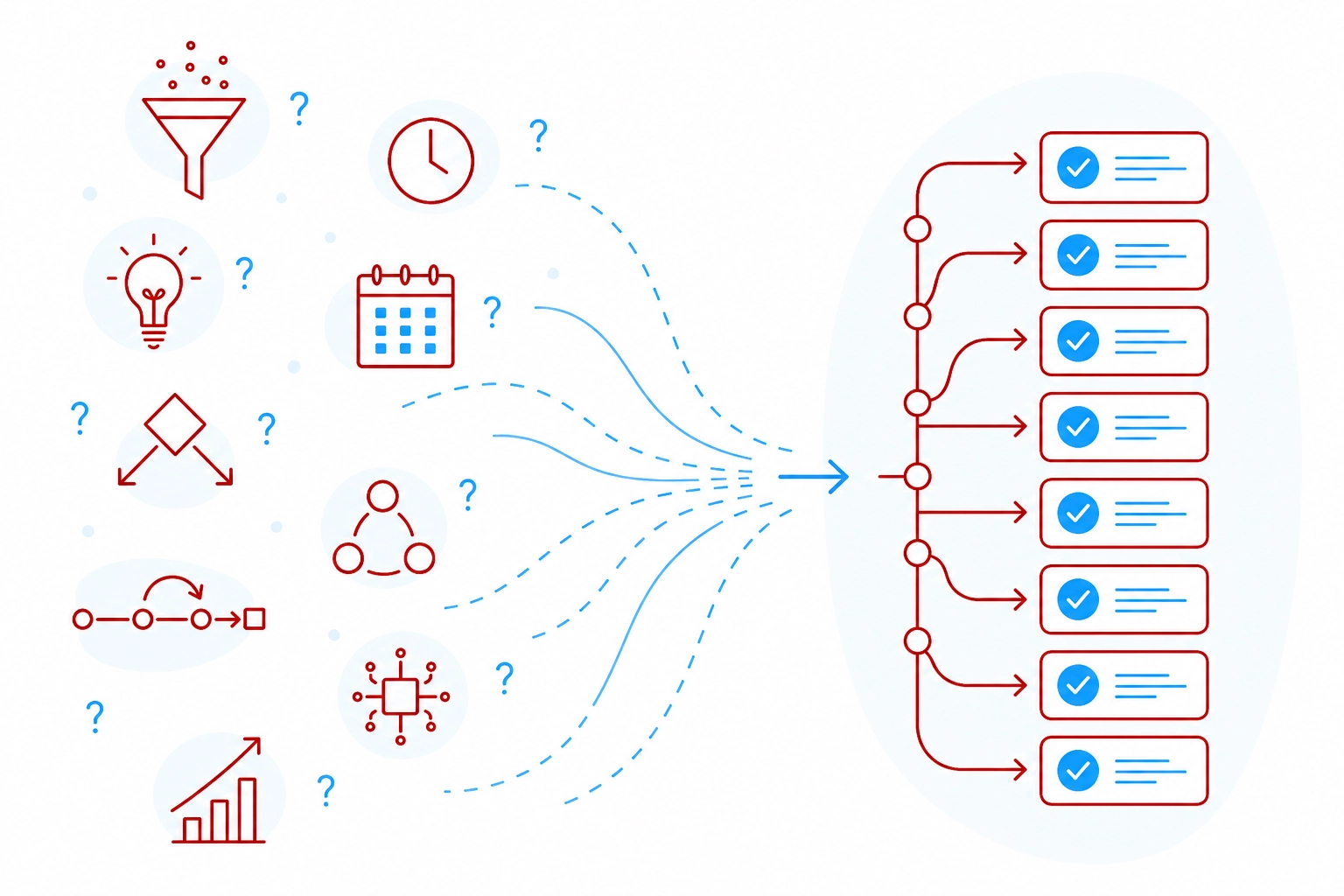
You Ask
We Answer
These aren’t just FAQs—they’re the patterns we see inside companies approaching an operational ceiling. If you’re leading a growing team and exploring how AI and systems can create leverage, these answers will help you diagnose gaps, clarify priorities, and move toward a more scalable operating model.
Fractional Chief of Staff for Startup CEOs
Keywords: fractional chief of staff, chief of staff on demand, startup operations, founder support, executive execution, startup scaling systems
Q1. What does a Chief of Staff on demand (fractional Chief of Staff) do for a startup CEO?
A:
A Chief of Staff on demand turns a CEO’s strategy into coordinated execution by building the operating structure—priorities, communication, and workflows—so the company runs without relying on the founder for every decision.
They:
Translate priorities into clear, trackable plans
Align teams around goals and timelines
Establish operating rhythms (weekly, monthly, quarterly)
Drive follow-through on decisions
Identify and fix execution bottlenecks
Result: consistent execution, clarity, and momentum.
Q2. When should a startup CEO hire a Chief of Staff on demand (fractional chief of staff)?
A:
Hire a Chief of Staff on demand when growth outpaces your ability to coordinate execution—not when effort is lacking, but when structure is.
Common signs:
You are the bottleneck in decisions
Priorities shift or get lost
Projects stall before completion
Teams are misaligned
Headcount grows (10–50) without a clear operating system
At this stage, a fractional Chief of Staff is more effective than a full-time executive because the company needs structure before scaling leadership.
Q3. What specific functional roles can a Chief of Staff on demand temporarily take on for a startup CEO?
A:
A Chief of Staff on demand fills critical execution gaps while building systems so the role is no longer needed long-term.
They may act as:
Strategic Planning Lead: sets priorities and planning cycles
Operations Integrator: connects teams and workflows
Project Execution Manager: ensures initiatives get completed
Leadership Alignment Partner: aligns CEO and team communication
Decision Support Analyst: structures decisions with clarity
Interim Operations Lead: bridges gaps before key hires
Goal: stabilize execution now, build systems for independence later.
Founder Bottleneck
Keywords: founder bottleneck, CEO overwhelmed, decision bottleneck, startup growing pains
Q4: Why does everything still run through me?
A:
Because you are currently the operating system of your company. As your team grows, decisions, coordination, and visibility still route through you by default. When you hire me, I use Mantle OS™ to redesign how work flows so execution no longer depends on you being in every loop. That’s how we remove the bottleneck structurally.
Q5: How do I know if I’m the bottleneck?
A:
If your team needs your input to move forward, if decisions pile up, or if you’re constantly following up—you are the bottleneck. It’s not about how busy you are; it’s about how dependent the system is on you. I use Mantle OS™ to shift that dependency into workflows, ownership, and visibility across the team.
Q6: How do you actually remove the founder bottleneck?
A:
I don’t just delegate tasks—I redesign how execution works. Using Mantle OS™, I identify where decisions, communication, and coordination are getting stuck, then install systems that distribute ownership and create visibility. Your team starts moving independently, and execution no longer relies on your constant involvement.
When to Hire
Keywords: when to hire chief of staff, startup scaling stage, operations support, founder workload
Q7: Is this overkill for a small team?
A:
No—small teams often feel this problem the most. Without structure, even 5 people can create heavy coordination load for the founder. When you hire me, I use Mantle OS™ to introduce lightweight structure that creates clarity without bureaucracy. This helps you scale early, not react late.
Q8: When is the right time to bring you in?
A:
The right time is when growth starts creating friction. If execution feels inconsistent, communication is messy, or everything still runs through you—you’re ready. You don’t need to wait until things break. Mantle OS™ works best at the moment of strain.
Q9: What if I’m not ready for a full-time hire?
A:
That’s exactly when this model works best. You hire me as your Chief of Staff on demand, and I bring Mantle OS™ into your business without adding full-time headcount. You get immediate leverage without long-term commitment. It’s a flexible but powerful solution.
Mantle OS™
Keywords: business operating system, startup operations system, execution framework, AI operating system
Q10: What is Mantle OS™ in simple terms?
A:
Mantle OS™ is the operating system I use to run execution inside your company. It connects your strategy, communication, and day-to-day work into one structured system. Instead of relying on meetings and memory, your business runs on clear priorities and visible workflows. That’s how execution becomes scalable.
Q11: How is Mantle OS™ different ?
A:
When you hire me, you’re not just getting advice—you’re bringing in Mantle OS™ as the system I use to run Chief of Staff support inside your company. I work directly with your team to install workflows, structure your operating rhythm, and ensure execution actually happens. This is ongoing operational support, not one-time recommendations. The system becomes how your company runs.
Q12: What changes after Mantle OS™ is in place?
A:
You stop being the central hub of everything. Your team knows what to do, decisions move faster, and execution becomes visible without constant check-ins. Work flows through the system instead of through you. Most founders feel immediate relief and clarity.
Clarity Core
Keywords: business clarity, founder priorities, operational clarity
Q13: What causes a lack of clarity in a growing business?
A:
Lack of clarity comes from undefined priorities, shifting goals, and no central source of truth. As teams grow, information spreads across conversations and tools, creating confusion. Founders often rely on intuition instead of structured systems. Mantle OS™ makes priorities visible and consistent across the organization.
Q14: What does operational clarity actually look like?
A:
Operational clarity means every team member understands priorities, roles, and decision rules. It removes ambiguity and reduces reliance on constant founder input. Work becomes more consistent and predictable. This creates a strong foundation for execution.
Q15: How do you create clarity without slowing the team down?
A:
Clarity should simplify work, not add process. Most companies overcompensate by adding more meetings or documentation, which creates friction instead of alignment. I use Mantle OS™ to create lightweight clarity—clear priorities, simple decision rules, and visible workflows—so the team moves faster with less confusion. The goal is clarity that accelerates execution, not slows it.
Operating Rhythm
Keywords: chief of staff role, fractional chief of staff, startup leadership support, executive operations
Q16: Why do priorities keep changing?
A:
Priorities change because there is no structured planning system. Founders react to immediate pressures instead of following a clear plan. Without rhythm, execution becomes reactive. Mantle OS™ introduces cadence that stabilizes priorities.
Q17: Why do my meetings feel like a waste?
A:
Because they’re not designed to produce outcomes. Most meetings lack decisions, ownership, and follow-through. I redesign your meeting system using Mantle OS™ so every meeting drives execution.
Q18: What does a strong operating rhythm look like?
A:
It’s a predictable cadence of weekly, monthly, and quarterly alignment points. Each meeting produces clear outputs and reinforces priorities. AI supports preparation and follow-up. This creates consistent momentum.
Decision Systems
Keywords: decision framework, decision ownership, decision clarity
Q19: Why do founders become bottlenecks in decision making?
A:
Founders become bottlenecks when decisions are not systemized. Without clear ownership and rules, everything escalates back to the CEO. This slows execution and increases dependency. Mantle OS™ distributes decision-making so teams can move faster.
Q20: What is a decision-making framework?
A:
A decision-making framework defines who makes decisions, how they are made, and what criteria are used. It removes ambiguity and reduces unnecessary escalation. Teams can act with confidence instead of waiting for approval. This improves speed and consistency
Q21: How do you make decisions faster without losing quality?
A:
Faster decisions come from clarity and structure, not rushing. When decision ownership is defined and criteria are clear, teams don’t need to escalate everything or debate endlessly. I use Mantle OS™ to establish simple decision rules and visibility, so decisions can be made quickly with confidence. This improves both speed and quality at the same time.
Team Alignment
Keywords: team alignment, misalignment, shared priorities
Q22: Why is my team not aligned?
A:
Because alignment isn’t built into your system—it’s happening informally. Without clear priorities and visibility, teams interpret goals differently. Mantle OS™ creates structural alignment so work moves in the same direction automatically.
Q23: How do you align a team around priorities?
A:
Teams align when priorities are clearly defined, documented, and reinforced consistently. Alignment requires structure, not just communication. Mantle OS™ connects priorities directly to daily execution. This ensures alignment is maintained over time.
Q24: Why does alignment break down as my team grows?
A:
Alignment breaks down because communication doesn’t scale with team size. What used to work through direct conversations becomes fragmented across people, tools, and meetings. Without a shared system, each team interprets priorities differently. I use Mantle OS™ to create a single, visible structure so alignment holds even as your company grows.
Execution Engine
Keywords: workflow systems, accountability, execution tracking
Q25: Why do things get discussed but not completed?
A:
Because there’s no system connecting decisions to execution. Meetings generate ideas, but without ownership and tracking, nothing moves forward. Mantle OS™ turns every decision into structured, trackable action. That’s what creates follow-through.
Q26: Why do I keep following up on everything?
A:
Because progress isn’t visible in your system. Without tracking, the only way to know what’s happening is to ask. This turns founders into default coordinators. Mantle OS™ replaces follow-ups with real-time visibility.
Q27: What creates accountability in a team?
A:
Accountability comes from clear ownership and visible progress, not pressure. When tasks and responsibilities are tracked, people naturally take ownership. Mantle OS™ creates that structure. This removes the need for micromanagement.
AI Operations & Workflows
Keywords: AI workflows, automation systems, AI operations
Q28: How do I use AI without creating chaos?
A:
You don’t start with tools—you start with systems. I use Mantle OS™ to install AI only where leverage is being lost. This prevents tool overload and keeps AI focused on real impact.
Q29: What is an AI workflow?
A:
An AI workflow is a repeatable system where AI supports execution automatically. For example, meetings generate summaries and tasks without manual work. This turns one-off prompts into operational infrastructure.
Q30: How do you get a team to actually use AI consistently?
A:
Teams don’t adopt AI because it’s available—they adopt it when it’s built into how they already work. If AI requires extra steps, people won’t use it consistently. I use Mantle OS™ to embed AI directly into workflows—like meetings, reporting, and task management—so it becomes part of execution, not an extra tool. That’s what turns AI from experimentation into real operational leverage.
Results & ROI
Keywords: ROI, productivity, execution improvement
Q31: What results should I expect in 30–60 days?
A:
You’ll see clearer priorities, better meeting outcomes, and reduced coordination load. Your team starts moving with structure. Execution becomes visible. You feel immediate relief.
Q32: How do you measure ROI?
A:
ROI is measured through time reclaimed, execution speed, and reduced friction. Founders often regain 10–20 hours per week. Teams move faster with fewer delays. The impact is both measurable and tangible.
Q33: How does this impact team productivity in real terms?
A:
Team productivity improves when work is clearly defined, aligned, and consistently executed. Instead of spending time on coordination, clarification, and rework, teams focus on moving priorities forward. I use Mantle OS™ to reduce friction across communication, decision-making, and execution, which directly increases output. The result is not just more work done—but more meaningful work getting done faster.
Getting Started
Keywords: hire chief of staff, operations audit, clarity call
Q34: What happens if I hire you?
A:
We start with a diagnostic to identify leverage loss points. Then I implement quick wins using Mantle OS™ so you see immediate improvement. From there, we build your operating system step-by-step
Q35: What’s the best way to get started?
A:
Book a Clarity Call. I’ll quickly identify your biggest bottleneck and show you where Mantle OS™ would create the most leverage. You’ll leave with clear next steps.
Q36: What do I need to prepare before we start?
A:
You don’t need to prepare anything formal—just come with a clear sense of where things feel stuck or frustrating in your business. I’ll guide the diagnostic and help surface the real bottlenecks quickly. The goal is not to have perfect information, but to identify where structure is missing. From there, we can immediately start creating leverage using Mantle OS™.